Showing posts sorted by date for query krugman obama. Sort by relevance Show all posts

Wednesday, June 21, 2017

Noah Smackdown, illegal immigration edition


In February, I wrote a Bloomberg View post called "The Myth of the Immigration Crisis" that got a fair bit of attention. In it, I wrote:

Illegal immigration to the U.S. ended a decade ago and, according to the Pew Research Center, has been zero or negative since its peak in 2007: 


About a million undocumented immigrants left the country in the Great Recession. But even after the end of the recession, illegal immigration didn’t resume.
Now, my Twitter buddy Lyman Stone of the USDA has written a post alleging that my post is "bad" and "false". Well, my mom always told me "Son, don't **** with the USDA," and that advice has served me well for many years. However, given the importance of this issue, I may have to ignore my mother's wise words, and rebut Lyman's post. Which won't be that hard to do, because Lyman, being the perspicacious fellow he is, in fact agrees with me on almost every substantive point.


In which Lyman agrees with me on essentially everything important

I'm just going to shamelessly cherry-pick the parts where Lyman agrees with me and then goes on to cite more evidence in support of my thesis:
[Noah's evidence shows] that the illegal immigrant population has fallen since its peak. I 100% agree there. He’s totally correct. The stock of unauthorized residents in the US is almost certainly well below historic highs... 
Pew gets their estimate [of the number of unauthorized immigrants] by starting from American Community Survey 1-year estimates of the foreign-born population, then subtracting naturalized citizens. Then they use non-ACS data to estimate how many non-citizens are lawful permanent residents (LPRs) or legal temporary residents (LTRs). The residual must be unauthorized residents. 
This is the best method we have available and Pew does very good work. I have no criticism of Pew’s estimates insofar as they go.. 
Now, again, we can say with substantial confidence that the illegal immigrant population was declined since 2007... 
Let me be clear. I think Noah is [quite a handsome dude, and is also] correct that net migration of illegal immigrants has been negative in some periods since 2007. And I am very confident that he is correct that the illegal immigrant population is falling... 
What frustrates me is that Noah’s basic point, that illegal immigration is a vastly smaller problem now than 10 or 15 years ago, is totally correct. There’s tons of data to support it...He could have just shown the trend in border apprehensions, or shown the illegal immigrant share of the population, or other kinds of data. If he really wanted to be clever, he could have just lined up border apprehensions with deportations by fiscal year to see what direct migration trends might look like...
OK, I might have taken a few liberties there with the brackets, but the point is, Lyman agrees with me that according to the best estimates we have available, the population of unauthorized immigrants in the U.S. has fallen from its peak. Given that he agrees with both my thesis and the substance of my point, it strikes me as a bit odd that he characterizes my post as "false" and "bad", but as a man who once pasted Paul Krugman's head on a giant cartoon robot, I probably shouldn't criticize bloggers' use of hyperbole.

Lyman is also right that if I expressed the unauthorized population as a percent of the total, the decline would be even more stark. I'm not sure what increased border apprehensions tell us.

So, to reiterate, Lyman agrees with my basic point. The rest of his post consists of A) quibbles about vocabulary and messaging, B) a dubious point about error bars, C) an interesting but ultimately non-game-changing point about mortality, and D) bikini pics of Jim Heckman from 1971.

Well, no, not (D). Lyman's many things, but he's no monster.


Like, dude, what does "illegal immigration" even mean? 

First, note that following Bloomberg convention, I say "unauthorized immigrants" as the noun and "illegal immigration" as the verb. Because an act can be illegal, but a person can't (though I'm sure Jeff Sessions is working on it). So git off my back, y'all SJWs.

Anyway, when we talk about "the amount of illegal immigration", what does that mean? It could mean a couple things:

1. Gross illegal inflows: The number of people who enter the U.S. illegally or overstay their visas over a given period of time

2. Net migration of unauthorized immigrants: The number of people who enter the U.S. illegally or overstay their visas, minus the number of unauthorized residents who exit the country, over a given period of time

What the Pew numbers report, and what I reported, was neither of these. I reported the net change in the unauthorized resident population, That is similar to #2 above, but also includes the effect of mortality (as I'll talk about in a bit).

Anyway, which number do people think of when they hear "illegal immigration"? I'm sure some people do think of the first one. If you're a law-and-order type who is really upset about our porous border, then I'm sure you care about gross flows across that border. Lyman thinks that gross illegal inflows = the One True Definition of the term "illegal immigration":
The point is, everyone who works in this field, all the actual experts, including the folks at Pew whom Noah cites, use “illegal immigration” to refer to inflows which do not have legal authorization. That’s what the term means. It’s not just me. Here’s dictionary.com:


It means inflows. Exclusively.
Well, call me a lawyer, but it seems to me that if you're going to cite dictionary.com to tell you what "illegal immigration" means, you should at least use the dictionary.com page for "illegal immigration" (which BTW doesn't exist).

But that's not the point. The point is come on, brah, my Bloomberg post wasn't fooling anybody. First of all, I define exactly what I mean by "illegal immigration", because the graph is labeled "Annual change in unauthorized immigrant population". It's right there in the graph! I defined my terms! Neener!!

Second of all, that graph has negative numbers on it. How big of a critical theorist dum-dum do you have to be to think a negative number represents gross inflows? Gross inflows can't go negative! They are bounded below by zero! They are defined on the set Z+! Is there someone out there looking at my chart and mistakenly believing that half a million antimatter people snuck across the border in 2008??

God, I hope not. Please let there not be such a reader. But if there is, I'm not sure what it would take on my part to avoid misleading him.


OK, down to brass tacks. What number should we care about here?

Like I said, if you're the type of person who lies awake at night fuming that someone managed to sneak past the almighty Border Patrol unnoticed, then you care a lot about gross illegal inflows. I don't, really. Oh, I think there are a few reasons to care - linguistic assimilation, for example. If the unauthorized population keeps getting switched out, it'll slow the rate at which that population becomes proficient in English, the language of dubbed anime American business and culture. In fact, that's probably one reason unauthorized immigrants tend to assimilate more slowly.

But overall, what I mostly care about - and what I think everyone else should mostly care about - is the stock of unauthorized immigrants living in the country at any given time. First of all, this is what should matter for labor markets. The data has convinced me that the labor market impact of low-skilled immigration is small, but I'm not 100% certain of that, and even a small negative impact on America's most vulnerable workers is bad. But it's the stock, not the gross flow, of unauthorized immigrants that should determine the severity of labor competition faced by low-wage American workers.

Also, the stock is what matters for the welfare state. Low-skilled immigrants probably take as much or more in govt benefits as they pay into the system in taxes, so unauthorized immigrants put pressure on the sustainability of the welfare state. But again, it's the stock, not the gross flow, that matters for welfare payments.

So if what I care about is the stock, why do I talk about changes in the stock? Why do I act like there's no problem just because the stock is hovering at a constant number?

It's all about urgency. If the total number of unauthorized immigrants isn't increasing, there's no reason to panic. There's no reason to start calling for a big shift in our immigration policy. The Obama approach of increased border security and increased criminal deportations is doing a great job of keeping the U.S. from being swamped by illegal immigration, even if it didn't do a great job of winning anti-illegal-immigration voters over to the Democrats.

So I feel like by using the term "illegal immigration" to mean "the change in the total number of unauthorized residents", I was getting at the quantity that really matters.


Did I ignore margins of error?

Yeah. I reported point estimates without talking about margins of error. Let he who is without sin cast the first Stone.

SEE? It was a pun! Lyman's last name is Stone! Get it?? BUAHAHAHA

...OK, anyway. Let's talk about margins of error. Lyman produces a graph of year-on-year changes in unauthorized immigrant population with some error bars he cooked up:


Wow, what looks like zero could actually be an increase of half a million unauthorized immigrants per year, right??

Wrong. The errors don't add up over time. If Pew were measuring border crossings and using that to infer the total unauthorized population, then yeah, the errors in their estimates would cumulate. But what they're doing is re-measuring the unauthorized population over and over each year. Which means that if we want to measure the change in total unauthorized population between Time A and Time B, we don't care about any of the measurement errors in between A and B.

(Random note: Blogger's spell-checker doesn't recognize "cumulate". What sort of fallen world do we live in?)

OK, anyway. I don't know how Lyman produced the graph you see above, since he doesn't include his methodology. It sort of looks like he just added up Pew's standard errors on the yearly population estimates for each pair of years, and then added maximum potential rounding error to each year. But I am an honorable man, and Lyman is an honorable man, and I would never accuse him of making such an undergrad-level math mistake. 

In any case, let's talk about how you calculate the error bars of a difference. 

So, let A be the total number of unauthorized immigrants in 2007, and B be the number in 2014. What we're interested in is the quantity B - A. We have unbiased estimates of B and A, and some random measurement errors e_B and e_A:

Bhat = B + e_B

Ahat = A + e_A

Suppose we want the variance of the difference between our two estimates: Var(Bhat - Ahat) = Var(e_B - e_A) = Var(e_B) + Var(e_A) -2Cov(e_B,e_A)

So the more correlated our measurement errors are between 2014 and 2007, the smaller the error bars will be on the difference of the two estimates. This is a fancy way of saying that if we miscount by the same number of people each year, we get the change in the total number of people exactly right, even if the amount we miscount by is huge. 

I was going to try to write down an expression for serially correlated errors here, with an autocorrelation coefficient of f, so I could use Cov(fe,fe), but I was too lazy.

So the more serially correlated the errors in the ACS and CPS estimates (which are used to derive Pew's estimates) are, the smaller the error bars should be on the difference between the estimates for two years. And I do suspect there is some serial correlation there. Suppose there's some group of unauthorized immigrants that these surveys reliably miss every year. Even if these groups are large - say, 1 or 2 million people - the fact that they aren't measured adds only a little bit to our uncertainty about the change in the total unauthorized population. (That little bit comes from the change in that unobserved subpopulation itself.)

So that's one potential problem with what Lyman is doing here. A second is that he discusses rounding errors. Pew's numbers are rounded to the nearest 100,000, meaning that they can be off by 50,000 in a given year. But those rounding errors obviously don't add up over time! When calculating the change in the unauthorized population over N years, you only have two rounding errors, not N rounding errors. 

The third thing Lyman overlooks is that the intervening years between 2007 and 2014 actually do contain some information. They show remarkable stability: 


If the measurement error of the yearly first differences were really on the order of 400,000 per year, as Lyman's graph shows, we'd expect to see the numbers jump around a lot more than they do. In fact, after 2008, we never see changes that big. This means Lyman may have made a mistake in how he calculates his error bars, but it also means that Pew may have overestimated its own error bars for the yearly population numbers. (Unless ACS and CPS are smoothing these numbers year to year in some way I am unaware of, which would be a bit naughty!)

Anyway, it's possible that measurement error concealed a moderate amount of (net) illegal immigration between 2009 and 2014. But given the likelihood that the ACS and CPS miss a lot of the same people each year, the number is unlikely to be big. And there's still basically no doubt that (net) illegal immigration was negative between 2007 and the present.


Outmigration to Heaven

As Lyman points out, there are multiple reasons the unauthorized population can decline. One is that people leave the country. Another is that people die. In my Bloomberg View post, I ignored mortality.

The reason I ignored it was that I didn't think of it (an excellent reason, if I do say so myself). But thinking about it later, I confirmed that it isn't that big of a deal, quantitatively. 

The crude death rate for unauthorized immigrants is about 3.9 per 1000, according to this random paper that I got by googling, i.e. The Most Reliable Source Ever. That's close to Lyman's own guess of about half the crude death rate of the U.S. as a whole. Using Pew's point estimates for the total unauthorized population each year, and again ignoring error bars, that's about 357,000 unauthorized immigrant deaths between 2007 and 2014, and about 264,000 between 2009 and 2014.

Let's compare this to the difference in Pew's totals for those years (i.e. what I called "illegal immigration"). The difference between 2007 and 2014 goes from -1.1 million to around -743,000 - still a very substantial decrease. The difference between 2009 and 2014 goes from -200,000 to around +64,000, turning a small decrease into a very small increase.

I still feel justified in saying that (net) illegal immigration halted between 2009 and 2014. As Lyman writes:
Mortality, like adjusting for ACS population estimation errors, has only a small impact.
The impact on Lyman's and my productivity is more substantial.


Summing up

So, ladies and gents and zombie thralls of the USDA Advanced Weapons Program, besides a general agreement with my thesis and main point, what we have here are:

1. A vocabulary complaint

2. An insistence that I'm focusing on the wrong number, which may or may not also be a vocabulary complaint

3. The very real fact that I didn't mention error bars (Bad social science columnist! Bad!)

4. Some dubious and mysterious calculations of error bars

5. That time I almost made a Cov(fe,fe) joke

6. A real, useful point about mortality, which I forgot because I'm a critical theorist dum-dum, but which isn't hugely important in the quantitative sense


I don't feel that I come out of this one looking too bad. 

*turns around and sees horde of zombie USDA attack cows converging*

Gulp.


Update

A new study from a group at Yale illustrates my point perfectly. Using inflow/outflow data instead of survey data, they estimate the number of unauthorized residents in the U.S. at around 22 million, about TWICE the official number. But their estimates show the same net decrease from 2007 to now as the survey data show:
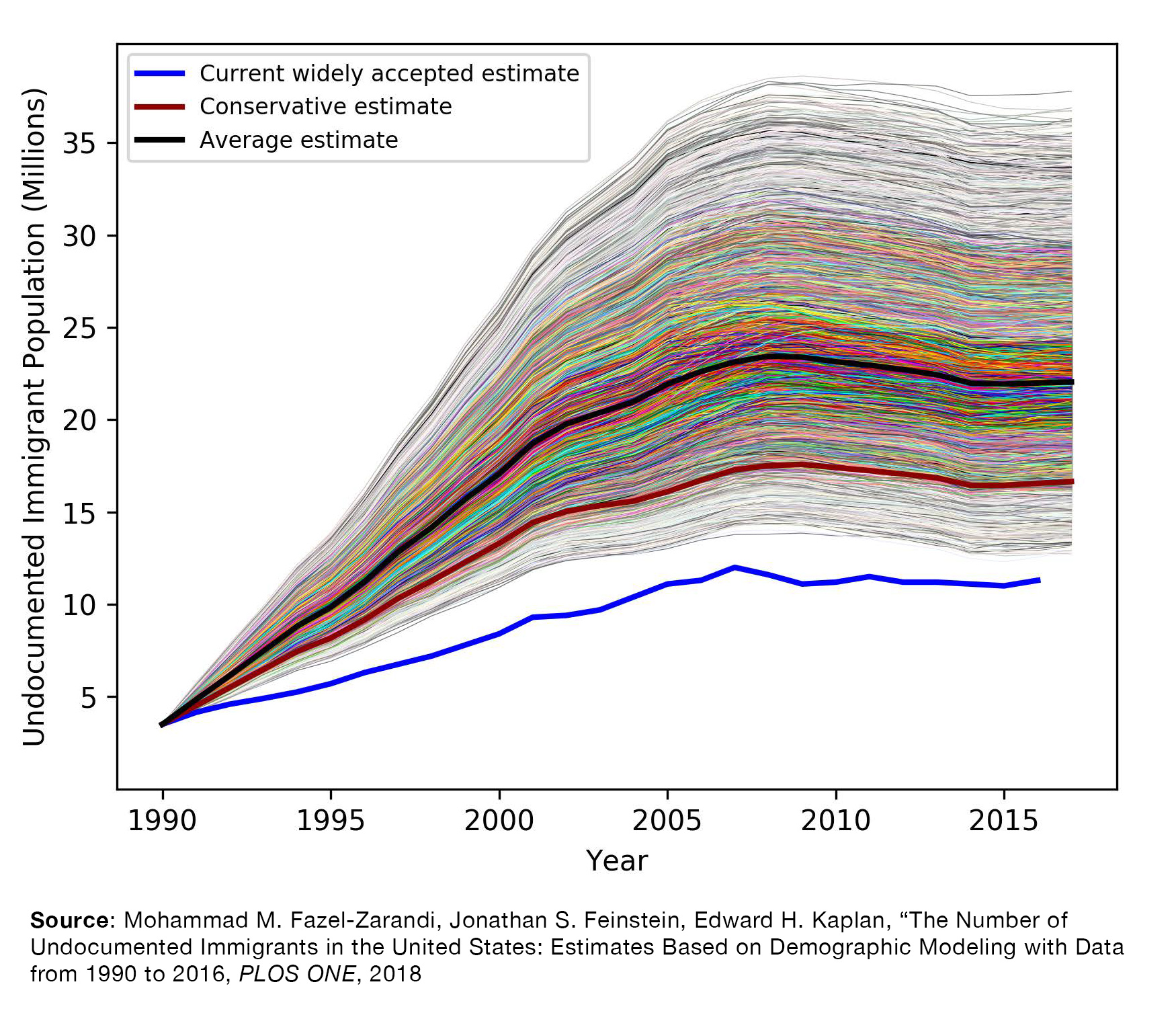
Chart of various estimates of undocumented immigrant population over time

Remember, big measurement errors in levels don't generally translate to big measurement errors in changes, due to serially correlated measurement errors (in this case, tending to miss the same people in each survey).

Sunday, February 08, 2015

Who do I admire most?


After the most recent results of Gallup's traditional "most admired" poll turned up some odd answers (Vladimir Putin??), Tyler Cowen asked his readers to identify their most admired living individuals. Well, there's little I like better than a good hagiography, so here's my list, in no particular order. Note that these are people I admire for what they're doing now. And of course the list is heavily weighted toward people in the media (and people I know); there are people working to take out terrorists, or discovering the technologies for better batteries, or working on cancer cures whom I would admire if I knew their names. With those caveats, here is the list:

1. Elon Musk


An obvious choice. But what other individual has the chance to singlehandedly save the world? Not only would electric cars help bring down oppressive petro-regimes all over the planet, but cheap batteries for cars and houses would be a huge help in the fight against global warming. Musk is the most important individual working to make those technologies happen.

People I admire for similar reasons: Danielle Fong, Lyndon Rive

2. Kathy Matsui


As you all know, women's equality in Japan is a big issue I care about. I'm also of the school that thinks that economic equality is a prerequisite for social equality. No one has done as much to promote the idea of "womenomics" as Kathy Matsui. Many of the changes we are seeing in Japan originated from the ideas of Matsui.

People I admire for similar reasons: Sayaka Osakabe, Akie Abe

3. Elizabeth Warren


I don't agree with Warren on every issue, not by any means. But no other person in the United States has been as tireless and effective about fighting the excesses of the 2000s-era industrial policy. Just pushing through the CFPB would be heroism enough for one lifetime. Warren will probably go down in history as the most important reformer of the current period.

People I admire for similar reasons: Paul Volcker

4. Shinzo Abe


I was once about as big an Abe detractor as you could find, back in 2006 when it seemed like he was undoing everything Junichiro Koizumi had accomplished. But then Abe transformed himself into the super-Koizumi, with some help from his wife and his economic advisers, made a stunning comeback, and is now transforming the Japanese economy and society in ways that will be mostly good.

People I admire for (somewhat) similar reasons: Koichi Hamada, Joko Widodo

5. Steve Chu


The energy crunch is humanity's biggest challenge, and it will take both government and the private sector to beat it. On the private sector Elon Musk is the icon, but in the government sector, Steve Chu is the biggest hero. Chu worked tirelessly to create a sensible energy policy that was diversified and that balanced the need for boldness with the fear of waste.

People I admire for (somewhat) similar reasons: Barack Obama

6. Marc Andreessen


Putting Marc on this list will cause me some embarrassment next time I see him on Twitter, but there's no way I could leave him off. Well of course he did kind of invent the Internet, but remember that this list is about current activities. Nowadays, as a venture capitalist, he's A) funding neat stuff, while B) working to define the culture of Silicon Valley in a positive way. Many other people do (A); few other people of such prominence do (B). Along with his wife, Laura Arrillaga-Andreessen, he's working to increase women's participation in the IT industry.

People I admire for (somewhat) similar reasons: Bill Gates

7. Jim Pethokoukis


Yes, this is a repeat from the "heroes of blogging" list, but oh well. Transforming one of America's two dominant political ideologies is a tall, tall order. Of all the people in the "reform conservative" movement, the one with the best vision and message is Jim Pethokoukis of the American Enterprise Institute. See here, here, and here for his attempts to grab the tiller of the conservative ship and steer it in a more rational, forward-looking direction.

People I admire for similar reasons: Michael Strain

8. Jon Stewart


There was a moment, sometime in 2005, when it seemed like Jon Stewart was the only sane man in America. American politics was still in a fever from 9/11, and the Iraq War and the second Bush election certainly didn't help. I still feel like the turning point, for some reason, was when Stewart destroyed the moronic show Crossfire on live TV. More importantly, Stewart has worked tirelessly for over a decade to expose the hyper-partisanship of our era for the joke it is.

People I admire for similar reasons: Stephen Colbert, John Oliver

9. Terence Tao


It's one thing to be the smartest human on the planet. It's another thing to be both the smartest human on the planet and a nice, well-adjusted person. We are raised on archetypes of the crazy smart guy - Isaac Newton slurping mercury, Grigori Perelman turning down a million dollars and living off of his mother's pension. Of course, it's not those guys' fault that they are oddballs, but symbolism is important. Tao is a new model of hypergenius -  a well-adjusted guy who shares his work on his blog, collaborates with everyone, and just has fun.

People I admire for (somewhat) similar reasons: Jim Simons

10. My "heroes of blogging": Brad DeLong, Annalee Newitz, Ramez Naam, Devin Stewart, Cory Doctorow, Phil Yu, Richard Florida, Paul Krugman, Barry Ritholtz, Mark Thoma, Miles Kimball, Justin Wolfers, and more!


Obviously, this is not an exhaustive list. But I'm exhausted now, in any case.


Update

Tyler Cowen posted his own "most admired" list, mostly consisting of everymen/everywomen in various important or dangerous positions. Good point - it's easy to forget the quiet heroism of normal people.

Thursday, September 18, 2014

Thursday Roundup, 9/18/2014


Do a Google Image search for "cowgirl", and you will learn something interesting about American culture. Anyway, here's Thursday Roundup:


Me on BV:

1. Lots of people use the word "Keynesian" as a synonym for "socialist" or "liberal". They should quit.

2. Sometimes you have to be a dick. But if you don't have to, don't.

3. What does "credit-fueled growth" even mean?

4. Government is an indispensable input into innovation.


From Around the Econ Blogosphere:

1. Matt Yglesias discusses Barack Obama's inscrutable, odd ideas about monetary policy. I keep telling people Obama is an Austrian, and no one listens.

2. If, like me, you are a really boring person, you can take a break from work by reading blog debates between New Keynesian mainstream people and Post-Keynesian heterodox people. Like this one. I mean, what else are you going to do with your free time? Tinder?

3. Matt Bruenig responds to my post about capitalist principles. He doesn't seem to quite get the idea of an ex ante reward or state-contingent assets, but overall, he's right - theories about what people "deserve" are utterly arbitrary. I'd like to see Bruenig debate Mankiw.

4. Ryan Avent, who always makes sure to write a post about anything I write a post about, on the exact same day, attempts to rebut Peter Thiel's techno-pessimism. I think Ryan is right.

5. People around the world are apparently much more pro-trade than we usually think.

6. Tim Taylor writes that we should have empathy for the poor, saying:
One could look across swathes of modern America and still write: "Whole sections of the working class who have been plundered of all they really need are being compensated, in part, by cheap luxuries which mitigate the surface of life." It is a failure of basic human empathy to blame the poor for behaviors that offer a way of mitigating the surface of difficult life circumstances.
What a commie. Go back to Cuba, you commie hippie. Greg Mankiw just flicked a gold doubloon into Tim Taylor's ear from the back of the class.

7. Christian Slater David Andolfatto interviews a scientician Mike Woodford about his views on Quantitative Easing.

8. Dean Baker has compressed his entire consciousness into a single blog post. There is no Great Stagnation.

9. In our age there seem to be very few truly original economic thinkers, going off the reservation the way that, say, Minsky did. But there is Michael Pettis.

10. Brad DeLong, Nick Rowe, and David Glasner ask: "What is a recession?"

11. I knew that eventually, someone would perceive a discrepancy between my endorsement of civility and my labeling of Austrian ideas as "brain worms", and would call me out on said discrepancy. I did not, however, expect that it would be Paul Krugman.

12. Speaking of Austrianism, it turns out that the Great Recession did not have a "cleansing" effect on the productivity of American businesses. It's almost as if...it's almost as if...things in the economy happen that are not the simple sum of optimal decisions by far-sighted actors operating in frictionless markets...but no, to quote Henry P., this question would carry us too far away...

13. T.P. Carney, whose name sounds more like a 19th Century circus promoter than any other I have encountered, makes a good point: Inflation allows employers to cut workers' real wages by stealth, simply by letting nominal wages stagnate. Actually, that's one of the reasons economists usually think that 2%, not 0, is the "right" target rate for inflation - in other words, economists like businesses to be able to cut real wages, so to them this is a feature, not a bug.

14. Mark Thoma launches a fusillade of shoulder-mounted heat-seeking missiles at Bob Lucas. Lucas, he says, by telling us to ignore recessions, stopped macroeconomists from thinking about the possibility of another Depression-like event in the years before 2008.

15. Matt Levine, the most entertaining finance journalist of whose existence I am aware, has a good run-down of the case against hedge funds as an asset class. See also Barry Ritholtz, who is the most entertaining-in-person finance journalist of whose existence I am aware.

Sunday, July 06, 2014

Can infrastructure "stimulus" unite Krugman and Cochrane?

(Over at Bloomberg View, I took a different approach to John Cochrane's WSJ piece. Here's what I wrote. In related news, I recently found out I'm allowed to repost the entirety of my BV posts 48 hours after they are published...)
John Cochrane, the University of Chicago Booth Business School finance professor and blogger, has an op-ed in the Wall Street Journalabout fiscal stimulus. Cochrane thinks stimulus isn't the answer, and cites his own research to show that the economic models used to justify stimulus spending are on shaky ground. Instead, he thinks that erratic government policy, taxes, regulation, and ham-handed attempts at redistribution are to blame.
I’m sure a lot of bloggers will jump in to counter Cochrane’s points -- David Glasner, for example, has a rebuttal already. I could write an article about how I agree with some of his points (I like his paper on New Keynesian models) and disagree with others (the alternative explanations he suggests have trouble explaining the Great Recession itself).
But I’m not going to write that article, because, frankly, this debate is kind of over.
There’s very little use in arguing about Keynesian stimulus spending, because no new Keynesian stimulus is on the table. In fact, there hasn't been serious consideration of a major new stimulus for years now.
What’s more, I think we’re starting to understand the political economy of stimulus itself -- when it is and isn’t feasible. Basically, when output is collapsing -- in the first few scary days of a recession -- we always do some kind of stimulus. Bush did it, Obama did it. As legendary macroeconomist Robert Lucas put it: “I guess everyone’s a Keynesian in the foxhole.” But once the economy is out of the foxhole, support for Keynesian spending dries up -- witness thefailure of Clinton’s attempt at stimulus in 1993 (two years after the end of the 1991 recession). Also, observe that despite repeated calls for new stimulus by Paul Krugman and Larry Summers -- almost certainly the world’s two most famous academic economists -- the Obama administration has given no sign of listening. Even back in the 1970s, when Keynesian economics reigned supreme, the idea that Congress could stabilize the economy had mostly been set aside in favor of the notion that this was the Federal Reserve ’s job.
So whether Cochrane or Krugman is right, stimulus of the pure Keynesian kind just ain’t happenin’. We need to think about what can be done to pull the economy out of its slump. Cochrane and his fellow-travelers propose a sweeping program of deregulation and dismantling of the welfare state, but that is also politically unlikely. One measure they endorse -- the ending of extended unemployment benefits -- has already been done, but so far doesn't seem to have forced many people back to work.
So what to do? Well, there is one idea that has the potential to appeal to both Keynesians and structuralists: repair our infrastructure. This is what Larry Summers is pushing for right now:
Who here is proud of Kennedy Airport?” Summers asked the audience. Not a hand went up...Summers seemed almost incredulous that the nation isn’t taking a golden opportunity to fix its crumbling infrastructure: “At a time when we can borrow for way below three percent and construction unemployment is high, why aren’t we building?
Let's be clear what the "fiscal stimulus" argument is and is not about...[it is not] about debt financing of "infrastructure" or other genuine investments. If the project is valuable, do it. And recessions, with low interest rates and available workers, are good times to do it. That doesn't justify all "infrastructure" roads and rails to nowhere, of course.
If infrastructure spending happens, people will undoubtedly label it “stimulus,” but the truth is that it’s something else entirely -- you don’t need a Keynesian multiplier to make it work. Let me quoteCochrane himself, from 2012:
So there are at least two big non-Keynesian reasons to unleash a wave of infrastructure spending right now. The first is that interest rates are low. Interest rates represent the government’s cost of capital, and as every MBA knows, you invest when the cost of capital is low. Second, America has an infrastructure deficit, as this McKinsey report makes clear. Some countries, such as Japan, spend too much on infrastructure, but we spend too little, and our roads, bridges and airports are in disrepair.
Now, conservatives and structuralists will naturally worry that infrastructure spending will be distributed inefficiently, going to wasteful pork instead of productive uses. That’s a valid worry, and it’s a reason why we should also try to encourage private investment in infrastructure, as Summers suggests. It’s also a reason to have organizations such as the American Society of Civil Engineers help oversee infrastructure-spending decisions. Another worry is the high cost of infrastructure in the U.S.; bringing costs down will actually involve making a lot of reforms that conservative structuralists like Cochrane probably would like, such as shortening environmental reviews and administrative costs, and allowing infrastructure contractors to pay lower wages.
So there is the chance here for a bipartisan deal on a policy to help boost our economy out of its continuing doldrums. Infrastructure spending can appeal to both Keynesians and anti-Keynesians. Let’s do it!

Monday, March 17, 2014

Do economists control our ideas?


John Maynard Keynes famously said: "The ideas of economists and political philosophers, both when they are right and when they are wrong, are more powerful than is commonly understood...Practical men, who believe themselves to be quite exempt from any intellectual influence, are usually the slaves of some defunct economist." And Nicholas Kristof recently wrote: "[E]conomists (including my colleague in columny (sic), Paul Krugman) shape debates on issues from health care to education."

Maybe our ideas are shaped by dead economists - Milton Friedman's libertarian vision, for example. But do living economists really hold such sway over the public discourse in this day and age? I'm not so sure.

With regard to the general public, only a few economists command real wide-ranging respect. Paul Krugman is the most prominent of these. But Krugman is an opinion columnist. When he writes about stuff outside his academic specialty - for example, race and politics - does he really carry more weight than his colleagues David Brooks, Nick Kristof, or Thomas Friedman? Maybe a bit more, but not a huge amount more. And there are not many Paul Krugmans out there. In lists of "top public intellectuals" and "most influential thinkers", few economists make an appearance.

Even in purely economic matters, economists don't seem to command the public respect one might expect. Sure, Robert Barro and Martin Feldstein pop up periodically in the Wall Street Journal to say that deficits or QE are bad, and Greg Mankiw rails against taxation of the rich in the pages of the New York Times. But there are a bunch of people saying the same thing (and the opposite thing), and it's not really clear to me that the stellar research careers of Barro, Feldstein, and Mankiw give these guys a greater power to move public opinion than the average WSJ staff writer or magazine pundit.

In fact, the general public seems to mistrust the verdict of economists on some key economic issues. Most Americans still seem to believe, for example, that free trade is not always a good thing, in defiance of economists' concerted (possibly too concerted) attempts to convince them otherwise.

There are some economists who successfully advance "big think" ideas - Richard Florida, Erik Brynjolfsson, and Tyler Cowen come to mind. But are these academics really more effective at this than, say, writers like Malcolm Gladwell? And among academics, aren't there psychologists and physicists and biologists whose popular books are just as powerful as those of economists? Steve Pinker is a good example.

Then there's Freakonomics, but I don't think anyone is the slave of Freakonomics. Though the phrase "slave of Freakonomics" is pretty fun to say.

How about elite opinion? People like Larry Summers and Christina Romer certainly seem to have some sway over the Obama administration, but overall their Keynesian advice was unable to overcome Obama's own instinct toward austerity and low deficits and structural reform. Art Laffer certainly seemed to have an outsized influence over Reagan and the GOP, but he's "the exception that proves the rule" (meaning, of course, that he's by far the biggest exception I can think of off the top of my head). In terms of broader elites - business leaders, opinion writers, Congressional staffers - it's more difficult to say.

How about effects on other fields? In the legal profession, there is the "law and economics" movement, which seems to have had a big effect. Economics made a push into the sociology realm with Gary Becker's "imperialist" econ, but that is no bigger than, say, psychology's intrusion into econ, or postmodern critical theory's intrusion into anthropology (Ha! See that? Random unprovoked anthropology diss!). And though you occasionally see an article about "the economics of sex", I don't think most people have yet bought into the idea that we can explain our daily lives with utility functions and Nash equilibria.

Actually, there has been somewhat of a pushback by other academics against the notion that economists are all-purpose sages. Physicist Mark Buchanan, for example, has been very vocal in challenging macroeconomics in public.

So if economists have outsized control over society's ideas, well, it's not that outsized. When it comes to the ability to exert undeserved influence over the minds of humankind, there's one group that blows economists, and everyone else, away:

Writers.

Sunday, February 16, 2014

Is macro doomed to always fight the last war?


The eternally simmering blog debate over "microfoundations" has reached a sort of balance, with Simon Wren-Lewis and Paul Krugman on the skeptical side, and Chris House, Steve Williamson, and Tony Yates in support of the dominant paradigm. But "balance" doesn't mean "boring", so I encourage you to read the latest round, which is about the history of New Keynesian macro. Wren-Lewis and Krugman say that New Keynesians, by embracing the microfounded approach, gave up an important type of modeling tool unnecessarily; House and Williamson say that the thing that was given up was not useful at all, so it deserved to go. (Update: John Taylor also jumps in.)

Instead of repeating my thoughts on the matter, I want to ask a different question. In his post, Chris House writes:
The main thing New Keynesian research has been devoted to for the past 20 years is an exhaustive study of price rigidity. If anything was holding us back it was the extraordinary devotion of our energy and attention to the study of nominal rigidities. We now know more about the details of price setting than any other field in economics. As financial markets were melting down in 2008, many of us were regretting that allocation of our attention. We really needed a more refined empirical and theoretical understanding of how financial markets did or did not work.
And in this earlier post, he writes:
If there is a model that really got taken to the woodshed during the financial crisis it was the New Keynesian model which had, until then, occupied a clearly dominant position in policy discussions and academic research.
This seems to be the overwhelming consensus in academic macro these days. It seems obvious to most people that the Great Recession was caused by stuff that happened in the financial sector; the only alternative hypothesis that anyone has put forth is the idea that fear of Obama's future socialist policies caused the recession, and that's just plain silly.

Before 2009 there was very little finance in mainstream macro models (the biggest exception being these models by Ben Bernanke and coauthors). In 2009 and after, lots of people outside the field noticed this fact and got angry at macro. But macro, to its credit, was not nearly as tone-deaf as its critics made it out to be - macroeconomists immediately started working on models of how the financial sector could wreck the real economy, and a couple years later, as far as I can tell, "financial friction macro" is almost the only game in town. (And it seems to be rapidly erasing the "freshwater/saltwater" divide.)

In other words, when macroeconomists saw something their models couldn't explain, they changed the models extremely quickly. Which was, of course, exactly the right thing to do.

But of course it would have been even nicer if macro had picked up on the finance thing more strongly before 2009. Then we might have been better prepared. Instead, macroeconomists in the 2000s and the 1990s were focused almost entirely on explaining the last big business-cycle events - the stagflation of the 70s (which seemed to fit with RBC models) and the Volcker Recessions of the early 80s (which seemed to fit with New Keynesian models).

Are macroeconomists doomed to always "fight the last war"? Are they doomed to always be explaining the last problem we had, even as a completely different problem is building on the horizon?

Well, maybe. But I think the hope is that microfoundations might prevent this. If you can really figure out some timeless rules that describe the behavior of consumers, firms, financial markets, governments, etc., then you might be able to predict problems before they happen. So far, that dream has not been realized. But maybe the current round of "financial friction macro" will produce something more timeless. I hope so.


Updates

Brad DeLong has a great (and long) post on the "microfoundations" debate, with which I agree pretty much completely.

Monday, February 03, 2014

Krugman the moderate


"Even Paul Krugman has been known to say some rather nutty things at times."

Chris House was a bit surprised when that statement received considerable pushback. It seems like an innocuous, throwaway line, sort of like when a political writer says "and of course the Democratic party has its extremists too." A gesture toward centrism. But is it true?

Krugman is a bit unusual, in being both an economist who talks about serious economics, and an unabashed political pundit. Since politics is a highly emotional and highly subjective area, I wouldn't be surprised if people's emotional reaction to Krugman's politics - or politics itself - bleeds into their reading of his economic writing. On top of that, there exists a contingent of right-wing quasi-economists out there in the blogosphere who think Keynesianism is communism (you know who you are). And Krugman himself does occasionally say mean things about his rhetorical opponents (though he is pretty humble when it comes to the topic of his own expertise).

But when looked at dispassionately, how "nutty" is Krugman's economics itself?

Krugman's ideas about the macroeconomy seem to be something like this:

1. Recessions are usually caused by some sort of aggregate demand shocks, and monetary policy affects demand. There is a short-term inflation-unemployment tradeoff. If monetary policy is too easy in a boom (or during a negative supply shock like the 70s), you'll get harmful inflation. So the Fed should lean against the business cycle with monetary policy.

2. Under normal circumstances, recessions can and should be fought with monetary policy alone. But if nominal interest rates hit zero, then unconventional monetary policy can only work if the Fed can convince people of its commitment to keep policy easy for a long time after the recession. Since convincing people of that is very hard, fiscal policy is a better tool when nominal interest rates are zero.

3. Recessions are usually temporary things. But if the economy's trend growth rate is too slow, we could enter a period of "secular stagnation", where nominal interest rates continually hit zero. In this case, we need something special to boost us back to the more normal realm of positive interest rates - a higher inflation target, for example. An asset bubble might also do the trick, though with very damaging consequences down the road.

Are these beliefs nutty?

#1 is absolutely non-nutty, and is probably the majority view in the macroeconomics community. This is very close to the view of Milton Friedman. It's the view of New Keynesian models, which are the dominant type of DSGE model used at central banks.

#2 is a somewhat unusual view, but not out of the mainstream at all. It's basically just the theory outlined by Mike Woodford (probably the most influential macroeconomist working in academia today) and Gauti Eggertsson in 2003. Other prominent macroeconomists, such as Bob Hall, have also called for fiscal stimulus.

#3 is a very unusual view, which goes by the name of "secular stagnation" and has recently been propounded by Larry Summers. It is a new idea, and has not yet been the subject of much academic research. So while this isn't a mainstream view, I would call it "new", not "nutty". It certainly doesn't contradict the mainstream ideas in #1.

What about macroeconomic methodology? Unlike most working macroeconomists, Krugman has criticized the mainstream DSGE methodology, calling for the use of "ad-hoc" models like Old Keynesian IS-LM as a supplement to the more complex, intricate DSGE models - the rationale being that those models can be modified more quickly in an emergency and are more effective at communicating ideas to policymakers (or even to oneself). He is in general very skeptical of the value of the whole DSGE/microfoundations revolution.

This definitely puts Krugman out of the mainstream...of macroeconomics. Only a few maverick macro people, like Ricardo Caballero, speak out against the dominant paradigm. But outside of macro, the sentiment is less iconoclastic; plenty of non-macro economists wrinkle their noses at the mention of DSGE macro models. Krugman, in his academic career, was a trade theorist, which is close to macro, but not so close that his attitude toward DSGE is rebellious and eyebrow-raising.

Now, Krugman's rhetorical opponents have, upon occasion, accused him of wanting to tear up all of modern economics and replace it with the literary wisdom of musty old books. This accusation is partly motivated by Krugman's famous 2009 New York Times magazine article, "How did economists get it so wrong?", which was a blast of frustration leveled at the macroeconomics and financial economics professions for having missed the possibility of a crisis. You can judge for yourself whether you think the article was nutty; personally, I think it was pretty typical of the sentiment at the time among not just the public, but many economists themselves.

But the accusations that Krugman wants to tear up modern economics are overblown. They are typically made by people who don't like Krugman's overall worldview and approach - in other words, people who aren't buying the particular brand of modern macroeconomics that Krugman is selling. That leads them to caricature his views. I'm sure similar things are said behind a few closed doors in academia as well, by those academics who don't like even Krugman's mainstream ideas.

This is similar to the way conservative media tried for years to paint Hillary Clinton as a dangerous radical left-winger, despite her moderate stance on most issues. It was effective rhetoric. It got a lot of news media to buy into the story of Hillary the left-wing radical. It probably forced her to vote for the Iraq War in order to maintain centrist cred, thus leading to the victory of Barack Obama in the 2008 primaries. But it was never a realistic portrait of Hillary.

Nor is the portrait of Krugman as a radical fringe economist accurate. His economics is somewhat out of the mainstream on certain points, but generally within the standard deviation.


Updates:

Paul Krugman has more. Note that I didn't say that Krugman took Idea #2 from Eggertsson and Woodford, only that the ideas are the same!

Tuesday, September 03, 2013

Four Ways to Answer Economics Questions


I recently came across a saying about the four ways of answering questions according to the PaƱha Sutta.
  1. There are questions that should be answered categorically [straightforwardly yes, no, this, that].
  2. There are questions that should be answered with an analytical answer, defining or redefining the terms. 
  3. There are questions that should be answered with a counter-question. 
  4. There are questions that should be put aside.
A lot of the questions that economists get asked a lot can be answered in all four ways. I thought it would be fun to play a little "Economics Q&4A." I'll provide a few examples. If you wish, chime in with your own Q&4As in the comments.

Q: Is economics a science?
  1. Yes.
  2. This depends on exactly how you define science and what you consider to be the bounds and scope of economics. For the most part, economists cannot do controlled laboratory experiments. You can see lots of people's opinions on this question here, and you can read Mark Thoma and Paul Krugman here.
  3. Does this really matter? If it were not a science, should we stop trying to do it?
  4. **goes back to work**
Q: Is all this quantitative easing going to cause an inflation problem?
  1. No.
  2. You are probably asking about the Federal Reserve's unconventional monetary policies. For an explanation of why they haven't (and probably won't) cause problematically high inflation, see these posts.
  3. What do you mean by inflation problem? Isn't it possible that a bit more inflation would be a good thing? Do you see any signs of an inflation problem? Don't we have bigger problems than inflation?
  4. **sighs**
Q: If households have to tighten their belts, shouldn't the government?
  1. No.
  2. By belt-tightening, I presume you mean reducing the deficit of the federal government. You might have heard President Obama say, in 2010, "Small businesses and families are tightening their belts. Their government should too." But households are different than the government. You can read some bloggers' reactions here and here.
  3. Is the government a household?
  4. **slumps**
Q: How should I invest my money?
  1. Wisely.
  2. This depends on your situation and your financial goals. I don't know of any guaranteed get-rich-quick investment schemes. You should probably try to diversify, and not keep all your money under your mattress or in gold. I'm also not an investment adviser, just a young academic economist with no experience, so I'm horribly underqualified to help you with this.
  3. How much money do you have? And what are your investment goals? And why are you asking an economics grad student?
  4. **shrugs wildly**
Q: Should we go back on the gold standard?
  1. No.
  2. Here is an excerpt from Barry Eichengreen's answer: 
"Envisioning a statute requiring the Federal Reserve to redeem its notes for fixed amounts of specie is easy, but deciding what that fixed amount should be is hard. Set the price too high and there will be large amounts of gold-backed currency chasing limited supplies of goods and services. The new gold standard will then become an engine of precisely the inflation that its proponents abhor. But set the price too low, and the result will be deflation, which is not exactly a healthy state for an economy...The distributional effects of deflation are no happier than those of inflation.... The populist revolt of the 1880s was stoked by farmers with fixed mortgages who labored under growing debt burdens and financial distress as a result of falling crop prices. Nor is deflation likely to support robust economic growth, as any close observer of the Japanese economy will tell you.... 
And even if we are lucky enough to get it right at the outset, consider what happens subsequently. As the economy grows, the price level will have to fall. The same amount of gold-backed currency has to support a growing volume of transactions, something it can do only if the prices are lower, unless the supply of new gold by the mining industry magically rises at the same rate as the output of other goods and services. If not, prices go down, and real interest rates become higher. Investment becomes more expensive, rendering job creation more difficult all over again. Under a true gold standard, moreover, the Fed would have little ability to act as a lender of last resort to the banking and financial system...Its proponents paint the gold standard as a guarantee of financial stability; in practice, it would be precisely the opposite." 
3. What have you learned from history?
4. **cowers**

Q: When is Noah coming back?
  1. In about 3 months.
  2. If you mean coming back to the blog, that will be in about 3 months. However, he has never left Twitter. If you mean coming back to the United States, I think that already happened. 
  3. What, don't you like us?
  4. **checks watch**
Your turn!

Wednesday, February 27, 2013

Why liberals shouldn't turn against immigration


Dean Baker easily could have gone into academia, or sold out and gone on to make big bucks consulting in the private sector. Instead he did neither, choosing to work in the less prestigious, less-highly-paid world of liberal Washington think tanks. The reason is that he cared about the American working class, and wanted to dedicate his life to fighting on their behalf. This is extremely laudable.

However, that doesn't mean I always agree with Dean's ideas for helping the working class. In the last month, he has written a number of pieces with an anti-immigration slant. For example, on Feb. 2, he wrote this:

It's true that a declining population means that labor will be in shorter supply. That means that the least productive jobs will go unfilled. That is the way economies develop and the reason that half of our workforce is no longer employed in agriculture. In the U.S. this would mean that we might have fewer restaurants and the convenience stores won't be open all night. In Japan, perhaps they won't be able to find workers to shove people into the subway cars in Tokyo. What's the problem?... 
This is not to argue against immigration or immigration reform. The way we treat people who came to this country to work...is an outrage and is bad for the economy. However readers deserve a more serious discussion of the issues involved... 
Some immigration to the country undoubtedly provides economic benefits. However in nearly all cases there will be winners and losers. For example, a large flow of immigrants at the low-end of the labor force will hurt the people who have recently immigrated to the country. Some of us may not consider that a good thing.
On January 19, he wrote a piece saying that China's declining working-age population is good for wages (implying that the same would be true for us). And on February 26, he wrote an article for the Guardian, again calling for shrinking working-age populations:

There is no reason why the prospect of a stagnant or declining workforce should concern the vast majority of people... 
The people who hire help – the very same who also dominate economic policy debates – are terrified over the prospect that they will have to pay workers more in the future. 
But the rest of us can sit back and enjoy watching them sweat as ordinary workers may finally start to see their share of the gains of the economic growth of the last three decades.
The anti-immigration implications of this argument should be extremely clear. If shrinking labor forces lead to higher wages, then large-scale immigration will depress wages. Hence, we should consider immigration restrictions as a way to boost working-class wages. Some other liberal think-tankers, such as Jared Bernstein, have been writing pieces in the same vein. I call this view "labor protectionism".

There are four big, big reasons why I think that "labor protectionism" is a very bad idea, and should be dropped from the policy platform of American liberalism.

Reason 1: Agglomeration Economies

We are not living in an Econ 101 world, in which most people are employed as farmers, working the land. Instead, we live in a world with "increasing returns to scale", where economic activity gets a productivity boost from being concentrated. We also live in a world with transport costs, where companies want to put their offices and factories where the workers and customers are, and workers and customers want to live close to where they can get goods cheaply. These facts are summarized by Paul Krugman's theory of "New Economic Geography," for which he won the Nobel Prize.

But also, we live in a world in which knowledge economies are of extreme importance; when people cluster together in cities, their productivity goes up because of the accidental (and purposeful) exchange of knowledge and ideas.

For these reasons, the vast bulk of America's GDP is produced in extremely densely populated cities. Check out this infographic:


A casual glance shows that America's output is highly concentrated in big cities like New York and L.A. Studies confirm that living in a big city increases a worker's productivity by a substantial fraction.

If we were to kick a bunch of working-class people out of NYC, would NYC wages rise for the working-class people who were left, because of an artificial shortage of low-skilled labor? Maybe. But if we did this too much, NYC would start to lose its huge productivity advantage, and the tactic would backfire, reducing the wages of the working-class people who remained (to say nothing of the people who got kicked out).

Now realize that our modern world is very globalized. Much of our economy depends on trade (in fact, much more than the percent of GDP directly taken up by trade!). In the global economy, agglomeration economies mean that capital will flow to the country where the most productive workers and the densest, highest-purchasing-power markets reside. In other words, immigration helps us remain at the center of the global economy.

Reason 2: Politics

As you may have noticed, America's more liberal major party just won a historic electoral victory. This victory has many Republicans and conservatives fretting that liberalism has won in the U.S. But it's not the margin of Obama's victory that is producing this hand-wringing; rather, it's how Obama won. Specifically, Obama garnered 71% of the Latino-American vote and 73% of the Asian-American vote. These are the country's two fastest-growing demographics. If they continue to lean so strongly Democratic, the GOP is looking at a long, long time in the wilderness.

But why did Latinos and Asians abandon the GOP? The Republicans used to get a much larger share of both groups' votes. Many believe that the strongly anti-immigration views and policies of the Tea Party GOP in the last few years sent a clear message to Latinos and Asians that the GOP was a nativist party (the beginning of this was the grassroots conservative opposition to George W. Bush's immigration reform plan).

If, at this moment of triumph, liberals themselves were to turn anti-immigration, it would reverse the enormous gains and squander the historic opportunity that the GOP's nativist blunders have offered us. Think about whether the GOP or the Democrats would be better for America's working class. It's a no-brainer.

Reason 3: Offshoring

In today's globalized world, capital is highly mobile; multinational corporations can put their factories and offices wherever they want. If we did manage to push up wages here in America by restricting immigration, companies can partially offset this by relocating overseas. The offices and factories will go where the labor is. That is probably exactly what is happening with Japan, where population is declining and immigration is heavily restricted, but real wages have been flat or falling for many years.

In other words, offshoring cancels out much of the effect of immigration restrictions. Of course, we could try to block that effect by restricting offshoring and trying to trap capital here in the U.S. Labor protectionism would thus require actual, general protectionism in order to be effective. But actual, general protectionism would be bad for our economy, including our working class. We depend a lot on trade.

Reason 4: Social Security

The most enduringly popular liberal social program in the U.S. has been social insurance, a.k.a. Social Security. But as everyone knows, Social Security is put under extreme fiscal strain if the population starts shrinking. This would give political ammo to Republicans who want to destroy this cornerstone of the New Deal. Thus, immigrants - who are relatively young, and who almost all work - are key to preserving our system of social insurance in an age of low fertility among the native-born.

The Alternative: Focus on High-Skilled Immigration

There is a clear alternative to labor protectionism. Instead of focusing on decreasing the supply of working-class immigrants, let's focus on increasing the supply of high-skilled immigrants! Dean Baker, in fact, hits upon exactly this solution when he writes:
[A] large flow of very highly educated immigrants, such as doctors, can get the wages of these workers more in line with the wages of professionals in other wealthy countries and provide large savings in areas like health care.
This is absolutely right, but it receives only a small mention at the end of an otherwise distinctly anti-immigration post. Instead, support for more high-skilled immigration should be the centerpiece of liberals' approach to immigration.

Remember, even in Econ 101, what matters for wages is relative scarcity, not absolute scarcity. What that means is, for a given number of working-class population, every additional high-skilled immigrant raises working-class wages. So if we increase the absolute numbers of high-skilled immigrants, we will automatically raise working-class wages.

And if we shift our immigrant mix toward high-skilled immigrants, by allocating more visas based on skills and fewer based on family reunification, the effect on working-class wages will be even more dramatic. This is the upshot of the Atlantic article that Adam Ozimek and I wrote on high-skilled immigration in June 2012.

Brad DeLong once wrote:
I think the United States needs more immigrants--more people willing to take risks and work hard to seek a better life for themselves and their children, and illiterates from Chiapas seem to me as good as doctors from Calcutta.
I also like both varieties of immigrants. But if you care about the income distribution, the two are not equivalent. High-skilled immigrants are better for American working-class wages than low-skilled immigrants.

In conclusion: If liberals go the labor-protectionist route, the potential gains (in terms of working-class wages) are miniscule, or even negative, while the potential losses (in terms of political advantage for the Democrats) are absolutely enormous. But if people like Dean Banker drop the labor-protectionist angle and throw their political weight strongly behind a shift toward high-skilled immigration, the potential gains are very large and the potential losses miniscule.

The choice is clear.


Update: Dean Baker responds. I can't say I'm happy with what he writes ("As far as less-skilled immigration, I would want it sharply limited"), but hopefully the logic of my post will sink in over time...